There are many interesting words associated with online business. To earn money online, it is always a good idea to know what these words mean. Two examples of such words are ‘dropshipping vs ecommerce’.
You cannot go into online business without actually knowing what options there are. Profitable businesses always place knowledge first! Further, how would you make good business decisions without knowing everything there is to know?
So read on for the explanations of what dropshipping and ecommerce are, and how they mainly differ from each other.
What is Dropshipping?
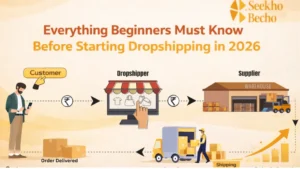
Dropshipping is one way of doing online business. A dropshipper sells products without having to keep them.
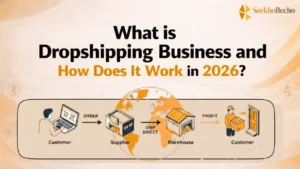
- You, the dropshipping business, partner up with suppliers who manufacture and keep the products.
- You display their products and bring customers to your storefront, where they place orders.
- You send these online orders to the supplier.
- The supplier sends the order to the customer.
- The customer only talks to you, which makes you responsible for all customer support.
Understand all the basics of dropshipping and the steps of how to start a dropshipping business.
Pros of Dropshipping
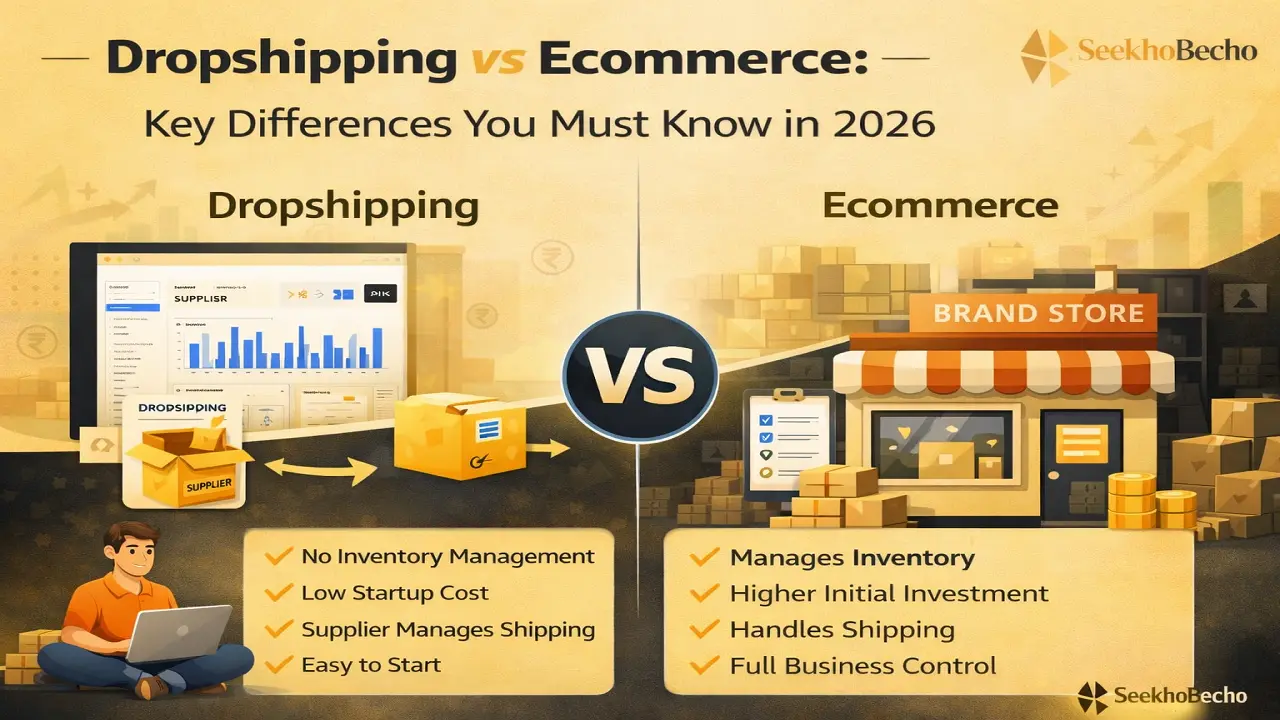
- More flexibility
- No inventory needed
- Minimal starting cost
- Quick business growth
Cons of Dropshipping
- Cannot customize products
- Lots of competition
- Less control over order fulfilment
What is Ecommerce?
Ecommerce is electronic commerce, which means the system of buying and selling online.
- The things being bought and sold could be goods or services.
- There are many channels of selling things online, be it through a website, social media, or e-commerce platforms.
- Some popular e-commerce platforms are Amazon, Flipkart and Meesho.
- Ecommerce is a broad term and contains different retail fulfilment methods or business models under it.
- In common usage, ecommerce refers to a traditional online business which both stocks and sells the product.
Pros of Ecommerce
- Can develop unique products
- Control over product quality
- Able to ensure good fulfilment process
Cons of Ecommerce
- More liability
- More responsibilities
- Higher starting costs
Dropshipping vs Ecommerce: 11 Differences
| Criteria | Dropshipping | Ecommerce |
| Category | Sub-category | Broader, main category |
| Inventory | None | Have to keep |
| Shipping | Not your responsibility | Your responsibility |
| Customer Support | Your primary responsibility | Your responsibility |
| Costs and Profits | Less costs, profits depend mainly on suppliers and marketing | More costs, profits depend mainly on product development and marketing |
| Risk | Low | Higher |
| Growth | Quicker | Can be slower |
| Flexibility | More | Less |
| Branding | Not through product | Mainly through product |
| Control | Less | More |
| Competition | Depends on niche, mainly centred on products | Depends on market research and product |
The main differences between dropshipping and ecommerce that any online business should know, are:
1. Dropshipping vs Ecommerce: Category
Ecommerce is the broad category and dropshipping is one of the methods that falls under it. Therefore, dropshipping is an e-commerce business model.
2. Dropshipping vs Ecommerce: Inventory
When people say ‘ecommerce’, they mostly mean traditional online business, where the seller of the goods holds inventory, that is, stocks the goods in their own warehouses. In the case of dropshipping, the seller does not keep any inventory. The products are kept by the supplier.
Dropshipping vs Ecommerce: Shipping
Traditional ecommerce sellers have to take care of shipping themselves, but dropshipping sellers are not responsible for shipping or fulfilment of the order. The dropshipping supplier is responsible for shipping the product to the customer.
4. Dropshipping vs Ecommerce: Customer Support
Both dropshipping and ecommerce sellers have to take care of customer support to make sure their customers are satisfied with the online shopping experience.
Customer support in case of dropshipping is a process of mediation between the supplier and the customer. Even if the issue and responsibility lies with the supplier, you have to be answerable to your customer because they only interact with you.
For traditional ecommerce, customer support is not mediation. Instead, it is just straightforward communication since the ecommerce business itself is responsible for fulfilment of the order. You are both responsible and answerable to the customer for any issues that occur with the orders.
Customer support is crucial for any online business, and most people do not focus on it. Don’t make this mistake!
5. Dropshipping vs Ecommerce: Costs and Profits
Costs and profits are calculated differently in dropshipping vs ecommerce. Dropshipping profits come from the difference between what the supplier charges you for listing the products and what the customer pays you for them. Mostly in dropshipping, you only have to pay for the products once you get sales, which means you need not worry about unsold stock.
Therefore, your dropshipping profits greatly depend on the supplier you find, how much they charge you, and what price you are able to put on the product for your customers. You have other costs too, such as website and marketing expenses. If you are dropshipping on an existing e-commerce platform, some of them also charge you monthly subscription fees, flat fees for products sold, shipping fees (if you choose to ship through them), etc.
In ecommerce, your profits come from the difference between your cost of manufacturing and/or storing and shipping the product, and what your customer pays for it. Your costs include factory costs, warehouse costs, staff salaries, overhead, marketing, website, and much more. Unsold inventory might be another cost you have to keep in mind, since you have to keep products in stock before you get sales.
So when you are thinking of ecommerce vs dropshipping, one of your main considerations should be costs and profits.
6. Dropshipping vs Ecommerce: Risk
You will have a lot less risk in dropshipping because the manufacturing or development of the product, and keeping it in inventory are not part of your job. So, you do not risk having unsold stock in dropshipping.
There are more risks in ecommerce. You might have unsold stock and other problems associated with manufacturing and inventory. This might especially become an issue if sales are low at a particular time.
7. Dropshipping vs Ecommerce: Growth
Growth occurs differently in dropshipping and ecommerce. It is easier to scale your online business in dropshipping because all you have to do is speak to your supplier and increase the number and/or variety of products you are listing. Another option is to get more suppliers based on the products you want to sell.
If you want to scale your ecommerce business, though, you have to increase your size of operations, and this includes many logistics and costs. It might take more time as well.
8. Dropshipping vs Ecommerce: Flexibility
Dropshipping is known for being a flexible business model for sellers. It allows you to easily test what products are selling and make changes or additions to your listings based on your tests. This is so because you do not actually need to worry about manufacturing or inventory.
Further, you can easily dropship anywhere and anytime, because all you need is a device and internet connection. You can have suppliers located anywhere in the world and send the products anywhere else, provided they have international shipping.
Ecommerce has less flexibility because you cannot shift your production or inventory too easily based on market testing. Moreover, for ecommerce you might have to be more connected to your base of operations, such as your factory and/or warehouse. Either you have to be present in case of any requirements, or hire staff who will handle things on your behalf, or in case of your absence.
In ecommerce, you might not be able to sell internationally with the same ease as you would find in dropshipping since you are directly involved in manufacturing and/or storage of products.
9. Dropshipping vs Ecommerce: Branding
Branding is another main difference between dropshipping and ecommerce. Dropshipping does not involve manufacturing or storage, that is, the product is not specific to your brand. Therefore, you cannot make the product customized to your brand. Branding cannot occur through the product itself. Therefore, your branding effort has to go towards your website or storefront, customer support, marketing skills, social media presence, etc.
In ecommerce, you can easily build a brand identity through the product itself, customizing it to your brand and making it recognizable. You can further support this branding through your website and/or app, marketing, social media presence, customer support, and more.
10. Dropshipping vs Ecommerce: Control
You might have realized by now that ecommerce gives you more control over the product, shipping time, branding, and more. However, dropshipping gives you a lot more flexibility and ease which ecommerce does not. Therefore, it is a trade-off. What you prioritize depends on your business goals.
11. Dropshipping vs Ecommerce: Competition
While there is competition in both ecommerce and dropshipping in an increasingly digital world, ecommerce competition is between sellers who sell similar products. Dropshipping competition can even be between sellers who sell the exact same products as they have the same supplier.
Therefore, dealing with competition requires different skills in dropshipping vs ecommerce. Dropshippers need to deal with competition through good dropshipping business ideas and niches, ingenious marketing, proper pricing, and strategies that allow them to scale quickly. Ecommerce sellers handle competition by focusing on making their product unique, as well as working on their marketing campaigns to reach more people.
Both online business methods require a lot of market research in order to rise above the competition. There are no shortcuts! However, as dropshipping gains popularity, there is a lot of good quality support available for dropshippers.
Should You Choose Ecommerce or Dropshipping?
When you’re choosing what’s right for you in dropshipping vs ecommerce, keep the below main considerations in mind:
- If you are someone who would like to take less risk, choose dropshipping. One of the main differences between dropshipping and ecommerce is that ecommerce has more risks.
- If you want to have more control over your product and operations, choose ecommerce. Dropshipping gives you less risk but also less control.
- If you prioritize growth, go for dropshipping. If you are okay with growing at a relatively slower pace while working more on product development and branding, choose ecommerce.
Don’t start an online business without the right support. Getting some help is always better.
Still Confused Between dropshipping vs ecommerce?
Expert advice is always a good idea. SeekhoBecho will answer all your questions with a free consultation and help you set up your online store today!
Frequently Asked Questions
1. What is the difference between ecommerce and dropshipping?
Ecommerce means the process of buying and selling online, where the seller holds the products in stock. The ecommerce seller buys the products in advance, before getting sales. Dropshipping is a type of e-commerce where the seller does not stock the product and instead just partners up with a supplier who handles stocking and shipping. There are other differences between ecommerce and dropshipping, which lie in the matters of growth, branding, control, etc.
2. Which is more profitable, dropshipping or ecommerce?
Both dropshipping and ecommerce can be profitable. Many people say that ecommerce has higher profit margins, but this is not true if you dropship using the right marketing strategies. Further, there is quicker growth in dropshipping, raising your profits rapidly.
3. Does dropshipping come under e-commerce?
Yes, dropshipping is a type of ecommerce model. However, when people say ecommerce, they mostly mean traditional online business models where the seller also stocks the products.
4. What are the two types of dropshipping?
The two types of dropshipping are becoming a seller on an existing e-commerce platform, or opening your own online store (website or app).
5. What are the disadvantages of dropshipping?
The key disadvantages of dropshipping are that you cannot customize the product, have to deal with competition from sellers with the same product and suppliers, and might have delays in shipping without your fault.
6. Can I start dropshipping with 10,000 rupees?
Yes, you can start dropshipping with 10,000 rupees or less. Dropshipping is known for its low starting costs. You can incur the least charges in the beginning by finding a supplier who does not charge any fees before you get sales.
7. Is Amazon also dropshipping?
Yes, you can dropship on Amazon. To do that, you have to create a seller account on Amazon.
8. How risky is dropshipping?
Dropshipping is a very low risk ecommerce method. Dropshippers do not need to hold inventory or ship orders, reducing their risk and effort.
9. Can dropshipping fail?
Dropshipping can fail only if you do not do proper research when selecting your market niche. Selecting a niche with too much competition and not having enough tools to rise above it can lead to failure. If you get dropshipping services, the chances of failure become minimal.
10. What skills do you need for dropshipping?
You need good marketing and customer support skills for dropshipping. You also need to be ready to grow your business, and have the patience to do proper market research before selecting products and suppliers.
11. What is the secret of dropshipping?
The secret of good dropshipping lies in selecting the right products, choosing the right suppliers, creating a good online store or storefront, using proper marketing strategies to bring customers to your online store, and providing reliable customer support.
12. Which skill is best for ecommerce?
The best skills for ecommerce and innovation of products, market research, resilience despite initial problems, and good marketing.