India’s e-commerce business landscape is entering into a high-growth phase in 2026, led by rising internet penetration, value-focused online shoppers and digital payments across tier 2 and tier 3 cities. For new and existing sellers, this is the right time to enter into a scalable ecommerce business model, including B2B ecommerce, dropshipping and marketplace-focused models.
India’s 2026 Ecommerce Growth Landscape
India’s ecommerce market is projected to grow rapidly, with estimates suggesting it could cross 160–170 billion USD in value by 2026, supported by strong consumer demand and policy stability. A major driver is the expansion of online retail beyond tier 1 and tier 2 cities into value ecommerce segments where penetration is expected to rise sharply by 2026.
Key growth enablers for e-commerce business in India include:
- Cheaper smartphones and affordable data plans.
- Widespread adoption of UPI and digital wallets.
- Logistics improvements enabling faster deliveries in non-metro regions.
High-potential ecommerce business ideas for 2026
In 2026, the most positive ecommerce business ideas combine low risk, high scalability, and niche positioning. Both beginners and professionals can grow by focusing on clear categories, strong branding, and efficient supply chains.
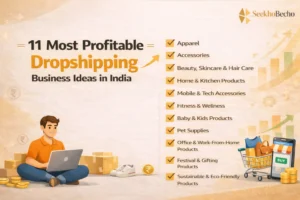
Top Ecommerce Business Ideas for India 2026 include:
- Niche fashion and accessories (handbags, printed t-shirts, athleisure).
- Category-focused B2B ecommerce (corporate gifting, bulk apparel, promotional merchandise).
- E-commerce dropshipping stores targeting trending micro-niches.
- Amazon’s ecommerce business models like FBA, private label, and brand storefronts.
Rising business opportunities in value and niche segments
Value-based ecommerce, where customers seek quality at affordable prices, is expected to see strong penetration growth by 2026, especially in smaller cities. Among the segments in this market that are expanding the fastest are clothing, fashion accessories, and everyday living items.
Focusing on particular categories helps new sellers establish a distinct brand identity and streamline operations. Because they offer design differentiation, the possibility of repeat purchases, and compatibility with both B2C and B2B e-commerce, products like handbags and printed t-shirts are appealing.
B2B ecommerce: a massive 2026 opportunity for an upcoming entrepreneur
Globally, B2B ecommerce grows faster than B2C, with double-digit expansion projected through 2026 via digital efficiencies. In India, platforms help entrepreneurs, retailers, and D2C brands source wholesale inventory seamlessly.
Key trends for 2025–2026:
- AI personalization and catalog recommendations for buyers.
- Self-serve portals and mobile-first access.
- B2C-inspired fast fulfillment.
Partnering with B2B suppliers like SeekhoBecho for handbags and printed t-shirts enables quick expansion without manufacturing costs perfect for Amazon dropshipping in India
Dropshipping Business: Low-Risk, High Margin
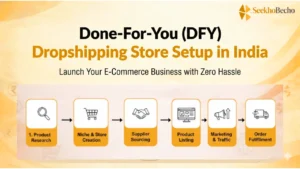
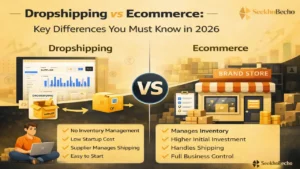
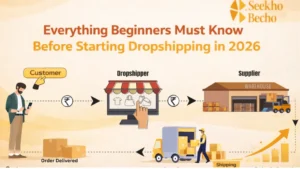
Dropshipping is one of the most beginner-friendly ecommerce business ideas for 2026 because it does not require upfront inventory. Sellers simply list products on their e-commerce website, and once orders start coming in, the supplier fulfils and ships them directly to the customer.
Why Dropshipping is attractive in India 2026?
- Minimal capital: No need to stock huge inventory or rent warehouses.
- Fast testing: Multiple designs or niches (like different handbag styles or printed t-shirt themes) can be tested quickly.
- Geographic reach: Sellers can reach customers across India while suppliers manage logistics.
Categories such as fashion, handbags, printed t-shirts, and lifestyle accessories are particularly well-suited to dropshipping due to design variety and consistent demand.
How SeekhoBecho Empowers E-commerce Dropshipping?
SeekhoBecho positions itself as a dependable B2B supplier and backend engine for e-commerce business owners who want to start with handbags and printed t-shirts. By offering ready-to-ship designs and catalogues, SeekhoBecho reduces the time from idea to launch for new dropshipping stores.
Ways SeekhoBecho helps your dropshipping or ecommerce business:
- Curated product catalogues of handbags and printed t-shirts suitable for Indian buyers and marketplaces.
- B2B-level pricing that allows healthy margins for online resellers and store owners.
- Streamlined fulfilment support so you can focus on e-commerce marketing and brand building instead of operations.
Key trends for 2025–2026:
- Link to your core dropshipping guide (for example: “How to Start a Profitable Dropshipping Business with SeekhoBecho in India”) from this section using anchor text like “dropshipping with SeekhoBecho” or “SeekhoBecho dropshipping guide”.
Amazon ecommerce business models to watch
Amazon remains one of the most powerful sales channels for ecommerce business owners in India in 2026, thanks to its reach and fulfillment network. Sellers can adopt multiple Amazon ecommerce business models depending on their capital and control preferences.
Popular Amazon e-commerce business approaches:
- Retail/online arbitrage: Buying products at lower prices and reselling on Amazon.
- Private label: Launching your own brand using existing manufacturers or B2B suppliers.
- Wholesale: Purchasing in bulk from B2B suppliers and selling at scale on Amazon.
- FBA (Fulfilled by Amazon): Leveraging Amazon’s storage and logistics for faster delivery and Prime eligibility.
For categories like handbags and printed t-shirts, collaborating with a B2B supplier such as SeekhoBecho enables private label or branded offerings on Amazon with consistent quality and supply.
Success blueprint for E-commerce Business in 2026
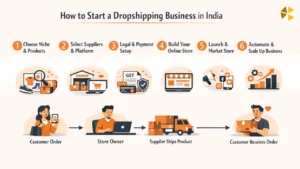
This step-by-step blueprint helps structure a successful e-commerce business in India in 2026, whether you choose a standalone store, e-commerce dropshipping, or an Amazon e-commerce business.
Step 1: Select the right ecommerce business model
Choose one of the following based on your capital and risk appetite:
- Pure dropshipping (no inventory, supplier-led fulfilment).
- Inventory-light model with small stock plus marketplace selling.
- Amazon-first business focusing on FBA or private label.
- B2B ecommerce play, supplying other resellers or corporate clients.
Step 2: Validate niche and product demand
- Shortlist categories such as handbags, printed t-shirts, athleisure, or niche fashion.
- Check demand on marketplaces through search volumes, bestseller lists, and reviews.
- Identify gaps in design, sizing, or messaging that your brand can fill.
Step 3: Partner with a strong B2B supplier
A reliable B2B supplier is crucial to maintain quality and margins. SeekhoBecho can act as your backend partner for handbags and printed t-shirts, offering consistent supply, design variety, and B2B pricing.
Look for suppliers who provide:
- Stable product quality and clear MOQ terms.
- Ability to handle both bulk orders and dropshipping fulfilment.
- Support for branding, packaging, or customisation where needed.
Step 4: Build your e-commerce presence
- Set up a branded e-commerce website or storefront (Shopify, WooCommerce, or custom build).
- Optimise the store structure for SEO, targeting keywords like “ecommerce business”, “dropshipping business ideas”, “e-commerce dropshipping”, and “B2B ecommerce”.
- Create high-quality product pages with clear descriptions, sizing details, and lifestyle images.
Step 5: Leverage marketplaces and the Amazon e-commerce business
Use Amazon and other Indian marketplaces as traffic and trust accelerators. Start with a small catalogue from your B2B supplier and gradually expand SKUs and categories based on performance.
Key best practices:
- Use FBA for your top-selling SKUs to improve visibility and conversions.
- Run Sponsored Product and Sponsored Brand campaigns to drive initial traction.
- Maintain strong account health metrics (on-time delivery, low return rates, positive reviews).
Step 6: Create a robust e-commerce marketing engine
E-commerce marketing in 2026 will be more data-driven and AI-powered, but fundamentals remain the same: traffic, trust, and conversions.
Core e-commerce marketing strategies:
- SEO and content: Publish blogs around ecommerce business ideas, how to start an ecommerce business, and category-specific guides (e.g., handbag styling tips, printed t-shirt trends).
- Social media marketing: Use short-form video, influencer collaborations, and user-generated content to build brand credibility.
- Performance marketing: Run targeted ads on Meta, Google, and marketplaces, focusing on profitable segments and retargeting.
Email and WhatsApp: Build owned audiences for repeat purchases, launch announcements, and offers.
Step 7: Optimize operations and profitability
In 2026, e-commerce success will be determined more by execution and margins than just growth. Sellers will be expected to manage healthy contribution margins while still scaling.
Operational optimization checklist:
- Monitor product-level profitability after ads, returns, and logistics.
- Use AI tools and automation for inventory planning, ad optimization, and customer support.
- Double down on high-margin categories like niche handbags and premium printed t-shirts.
Actionable strategies for e-commerce marketing in 2026
To stand out among fast-growing e-commerce business opportunities, your marketing must be consistent and insight-driven.
Practical marketing moves:
- Create SEO content clusters around “ecommerce business ideas”, “ecommerce business in India”, and “e-commerce dropshipping”.
- Run category-specific campaigns such as “office handbags for women”, “graphic printed t-shirts for youth”, and “bulk corporate t-shirts”.
- Use B2B-focused campaigns to attract resellers, retailers, and corporate buyers for bulk orders via B2B ecommerce funnels.
For SeekhoBecho, integrating educational content with product catalogues (e.g., “how to start dropshipping business in India”) can position the brand as both a teacher and supplier in the e-commerce ecosystem.
Conclusion
The fastest-growing ecommerce business opportunities in India for 2026 revolve around value-driven categories, agile models like e-commerce dropshipping, and scalable channels such as B2B ecommerce and Amazon. With a focused niche, strong B2B partners like SeekhoBecho for handbags and printed t-shirts, and a clear success blueprint, new and experienced sellers can build durable, profitable ecommerce businesses in the coming year.